ASTO

A word game, made solo

ASTO

This is to that. A word game about analogies, live at playasto.com.

Who made this

I’m Max Rowe, and I made ASTO solo: the design, the code direction, the editorial judgement, all of it. One name on the credits means every decision in this deck is attributable, including the bad ones.

As of August 17, 2026.

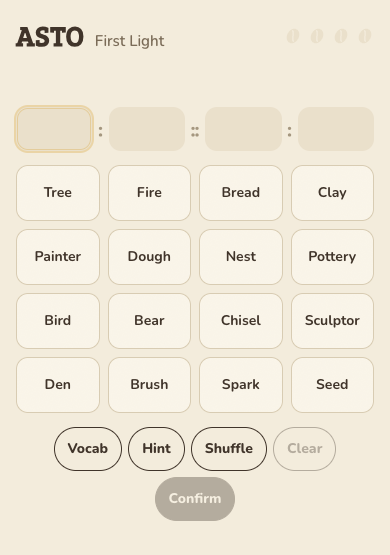
The ASTO board: sixteen cream word tiles in a 4 by 4 grid on a warm background, with an empty analogy frame above.

The idea

What I set out to do.

Two goals, named up front. Every slide after this one is evidence toward one of them.

Ship a real game that carries a feeling

Not a demo. A finished, public word game with a specific character: cozy, unhurried, built on recognition. Every puzzle had to clear an emotional bar, not just a validity check, and strangers had to be able to play it at a real address.

Learn to build it with AI

Two distinct learnings: building production software through AI tools as a non-programmer, and designing an agentic pipeline that authors content to a taste it does not hold itself.

The idea

Where to jump.

The deck reads front to back; the jumps work too.

The game

Four words, in order.

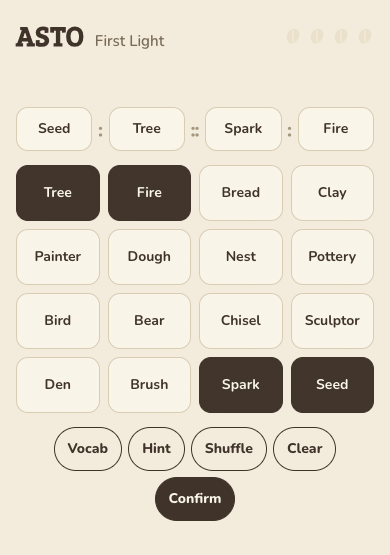
Connections, but with analogies: a 4×4 board of sixteen words hides four analogy sets. Tap four words to form A : B :: C : D, seed is to tree as spark is to fire, review the frame, press Confirm.

  • The whole board is the theme; each analogy holds a different relationship. The challenge is finding the relationships through words that all seem to belong together.
  • Order is the game. A submission is never sorted. The ordered claim is the claim (a true reading is accepted even when it isn’t the stored one). Half the machinery in this deck follows from that one choice.
  • The fourth tap fills the frame without submitting. You get to look at your own claim before you make it.
  • “So close!” (right four words, wrong order) costs a mistake and clears the selection. The penalty is also the hint. Repeating an identical failed guess is free; a different order is a new claim.

If you arrived from the game, this is the part you couldn’t see. If you haven’t played, one round makes it click.

The board with four tiles selected and the frame reading Seed : Tree :: Spark : Fire, with the Confirm button now active.
Four tiles chosen. Nothing submitted yet.

The feel

Recognition, not speed.

The puzzle is not “which words are similar?” It is “what relationship repeats across these pairs?”

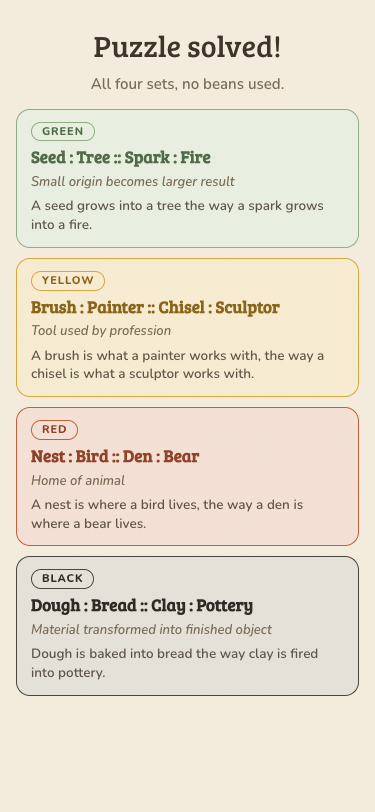
Four sets, four difficulty tiers, revealed on solve and never shown on the live board: difficulty is discovered, not warned about.

GREENYELLOW REDBLACK

Cozy is a constraint, not a mood. No timers, no confetti, no particles. Mistake pips are coffee beans and never red. Lose on the fourth mistake and the loss screen reveals every unsolved set with its explanation, so you always find out what you missed.

I declared the taste bar on day one, not once the pipeline made it necessary: it is not enough for a set to be valid, it has to feel like something. That standard has a name later in this deck, and a machine gets graded against it.

This deck is how ASTO was made. The game design document (v0.13, living) is what it was meant to be. They are companion reads.
The win screen listing all four solved sets with their tier badges, analogies and explanations.

The method

Why an agentic pipeline.

A puzzle game is hungry: it needs a steady supply of boards that all clear the same bar. AI could generate that scale. Generation alone was nowhere near trustworthy enough to publish.

One model call can’t hold the job. A publishable board has to satisfy sixteen unique words, one set per difficulty tier, four distinct relationship types, no accidental cross-set groupings, fair ordering, and a theme that feels like something. Asked for all of that at once, a model quietly trades constraints away and nobody can say which step failed.

So the job is split into agents with one job each: an author, a grouper, a rater, a builder, a row of evaluators. Each has a declared input and output schema. Each can be tested, measured and improved alone. When a board fails, the failure has an address.

And one judgement is never delegated: whether a board ships. Taste stays human. The machine’s job is to make my judgement cheaper to apply, not to replace it.

The intuition going in was that generating good pairs is the difficult part and assembling them is bookkeeping. That is backwards.

from my first pipeline’s lessons-learned

My first version was a five-agent Python crew, and it worked. I retired it anyway and rebuilt inside the game’s own repo, importing the game’s own validators: one schema, no drift between the thing that writes the puzzles and the thing that plays them.

The method

Tests are how I read code.

I’m not a programmer by training. I direct the code rather than write it, and that only works if trust never depends on my ability to eyeball a diff.

The discipline is boring on purpose. Every session opens by re-reading the plan and closes by verifying and recording. Every decision is written down with the trigger that would reverse it. The main branch only ever holds verified states, so any point in its history is a safe rollback. The repo carries its own memory; nothing depends on mine.

1,440tests passing, zero failing, on the platform’s own test runner
0dependencies: no framework, no build step, nothing in package.json

The suite turns “it works” from a feeling into a fact I can check. Nothing ships on my confidence.

The method

Nine agents, one deterministic gate, one human.

subject scout invents the run’s subject revision proposer called at review, and by auto-revise NOT PIPELINE STAGES 01pair author 02theme grouper 03difficulty rater 04board builder 04a integrity gate no model, no cost REBUILD, BOUNDED 05analogy validator 06adversarial solver 07test player 08style guide 09 glossary author one definition, or declines AUTO revise, once only on allowlisted flags HUMAN editorial gate corpus policies · examples with reasons · calibration versioned, inspectable, never self-modified ONE AUTO-REVISION PER BOARD · RE-RUNS 01–04 JUDGEMENT STEERS THE NEXT RUN

Every agent is a pure function with a declared input and output schema, and each one has exactly one job. The run is unattended: I’m only involved once a complete candidate board exists. The diagram is the tour; three stops deserve a word.

The revision proposer reads my feedback and drafts the fix brief: it proposes, never authors. Auto-revise is the one bounded repair the machine may make before I see a board, only on findings I explicitly allowlisted, and taste never triggers it.

  • 04a Integrity gate is deterministic code, no model: it checks every rule that can be checked exhaustively, including all 43,680 ordered four-word claims for accidental valid analogies.
  • 06 Adversarial solver tries to break the board the way a sharp player would: cross-set groupings, second readings. Its findings come back in the delegation lesson.
  • 09 Glossary author writes one definition for the board’s hardest word, and is allowed to decline: a definition that gives the set away is worse than none.

The method

Judgement needed a room of its own.

The pipeline only makes candidates. The other half is a local Review Studio where every board meets its editor: I start runs there, play the candidate exactly as a player would, and read each agent’s report beside the thing it judged. All 726 judgements that tune the agents were recorded in that room, and approving a board publishes it through the same validators the game loads.

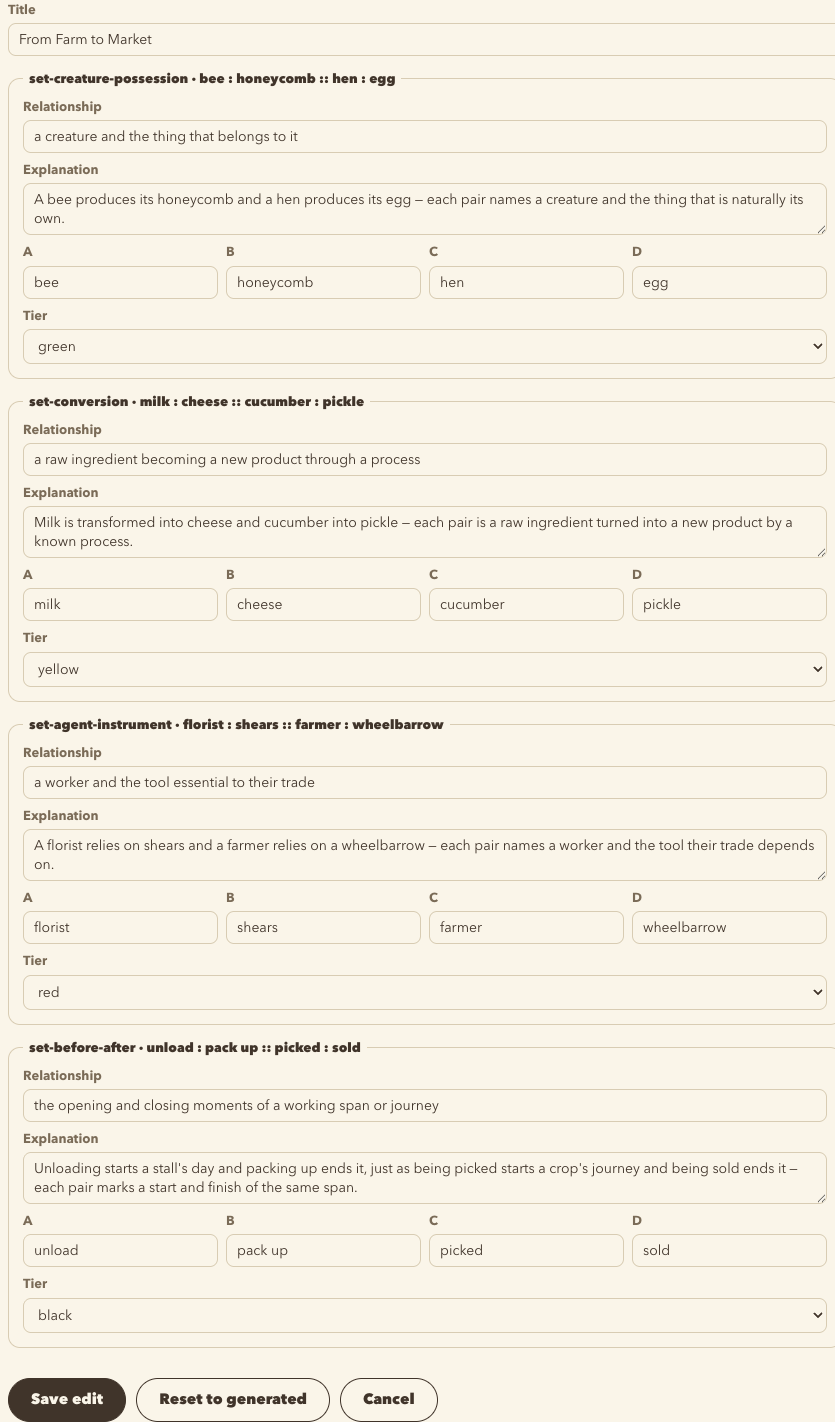
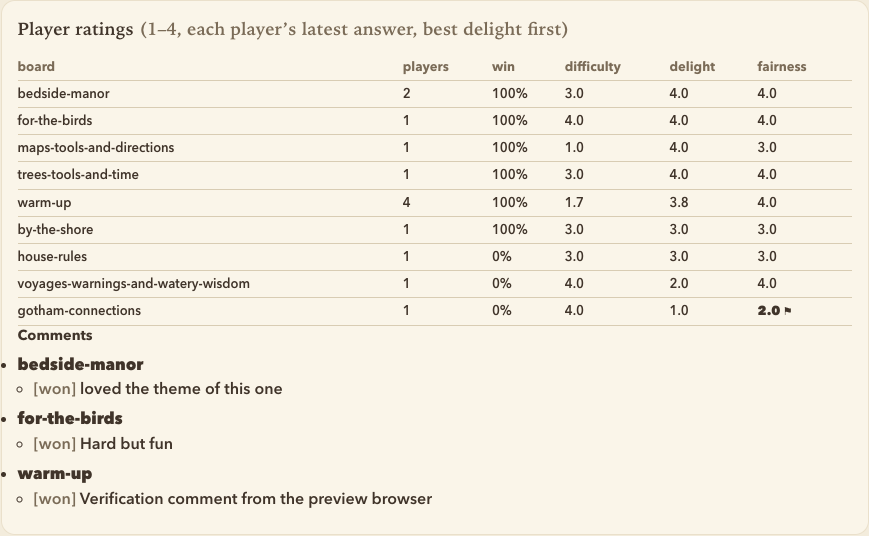
It grew with the project: first review and publish, then a player-ratings panel, then a hand editor where I fix a board in place, every save validated and recorded as before-and-after signal. Judgement becomes data here, and nothing publishes without me.

The Review Studio’s full review page for an approved run: the run header and publish panel, Play this board and Edit this board buttons, the style guide’s unity and evocativeness readings, the sixteen-tile candidate board, per-set cards with tier chips and taxonomy annotations, every evaluator’s report, and the feedback form with approve, reject and request-revision actions.
One run’s whole review page. Scroll inside the frame: the agents’ readings, the board, every per-set verdict, my feedback form, and the publish panel.
The hand editor open on the same board: editable fields for the title and, per set, the relationship line and the four words.
The hand editor: I fix a board in place, and every save is validated before it lands.
The player ratings panel: a table of published boards with players, win rate, and average difficulty, delight and fairness ratings.
The player-ratings panel: strangers’ judgements, one row per board, best delight first.

The method

The model has limits. The agents were redesigned around them.

The early failures were not prompt problems; they were lessons in what a model structurally cannot do. Four principles, each paid for by a real dead run.

What I learned

Borrowed expertise beats invented expertise.

Every board was starting to feel the same, and the corpus said why: ~80% of all 284 pairs ever authored were the same relationship, one thing becoming or producing another. The obvious next move was to write my own taxonomy of relationship types from taste, and steer the pipeline with it.

I can’t be fully relied on to create a foundation for analogies because I am not an expert. I’m merely interested in playing them.

the note where I stopped myself

So I didn’t write one. I went and found one: Bejar, Chaffin & Embretson (1991), developed at ETS to classify GRE verbal analogy items, and compiled it into a controlled vocabulary the pipeline actually runs on and is checked against.

The honest audit

Mapping my existing corpus onto the borrowed taxonomy showed exactly how narrow my own range had been:

  • Family 8, cause & purpose, was roughly 80% of everything.
  • Families 1, 3, 5 and 6 had never appeared at all.

A vocabulary you can count against turns a vague feeling, “these all seem similar”, into a number you can steer with.

The literature even validated two of the game’s earliest instincts, and the framework still had to be borrowed.

What I learned

The taxonomy was right, and it didn’t work.

Round 1. A board built with one set from each of four formally different families. I played it blind, and it read as “all the same, an object moving forward in time somehow.” I demoted three of the four tiers. The experiment invalidated its own design: formal diversity produced zero felt diversity, because every set still carried an arrow: a direction, a before and an after.

Round 2. Blind again, board letters flipped, with an equally evocative control so the effect couldn’t be a theme artefact. The mixed arrowed/arrowless board came back as “the best puzzle yet… This is ASTO.” I rejected the all-arrowed control and named the effect without knowing which board I was holding: “another ‘arrow’ puzzle.”

And then I deliberately did not make it a law

Recorded as decision D-3, marked n=2, hypothesis not law, with a written trigger naming what would have to happen to overturn it. “Let’s make sure we don’t view the revised principle as immutable.”

The result, as the Studio recorded it

approved …night-experiment-b mixed arrowed / arrowless
rejected …night-experiment-a all four sets arrowed

Same theme, same night, same evocativeness, letters assigned blind. The only variable was whether every set pointed in a direction.

Two sets from the board that earned it

GREEN
Firefly:Glow::Cricket:Chirp

the night creature and the signal it gives off

BLACK
Shadow:Weight::Ghost:Footprint

the one thing it can never have

The green points somewhere: a creature and what it emits. The black points nowhere at all, and it is the set this game exists for. One arrowed, one arrowless. The mix is the finding.

How taste gets measured at all: the feedback form was rebuilt around how I actually judge, its tags compiled from my own prose notes and board verdicts separated from set verdicts. Every number in this deck rests on that instrument.

What I learned

Delegation is earned, and bounded.

The machine is allowed to fix a board before I ever see it. It earned that authority against a standard I wrote before the feature existed, and the bound on it is the interesting part.

I rejected two boards for two specific defects, then found the adversarial solver had already flagged both, in almost the same words, with nothing routing its findings anywhere. I was re-deriving by hand what the pipeline had written down.

[medium] cross-set-association Museum, Louvre… Louvre and Musée d’Orsay are themselves extremely famous museums
[high] unfair spy, alias, operative, cyanide pill near-synonyms… stock spy-gear items
  • The standard came before the feature. Decision D-5, written while there was nothing to grade: about ten fix briefs with recorded verdicts, accepted substantially unedited, before any loop gets proposed.
  • Then the evidence arrived. Fourteen proposal verdicts on the record, every one accepted. On one batch the machine flagged every structural defect I independently caught, before I saw the boards.
Three zones, drawn in advance

Deterministic checks are automated outright. AI revision runs only on an allowlist chosen by me and revocable by me: cross-set findings at high severity and the order-ambiguity cluster, nothing else, one auto-revision per board. Taste never triggers a revision. A failed repair sends the board to me carrying both the findings and the diagnosis.

Order fairness is the allowlist’s other half. An analogy that reads as truly backwards (seed : bud :: bloom : wilt, where I lost a mistake to a coin flip) is a fairness bug, not a style note, and three detectors now catch that shape. All three report and none can block: a wrong fix gets reviewed by a person, but a wrong veto silently costs a good board. Signals, deliberately not gates.

What I learned

An instrument, not a mirror.

A read-only tool re-runs any evaluator against any board in the archive, so the agent is the only variable. Same board, same model, same effort setting, eleven days of prompt work apart.

[Aug 5] the old style guide unity: strong
[Aug 16] the same stage today evocativeness: strong

The second answer is to a question the first version had no field for. The axis did not exist yet, so the old agent could not have been wrong about it. It could only be silent.

And it disagreed with me, out loud

I had called that board an absolute snooze. Today’s agent answered strong, and went on to praise the exact wording my own note had wanted sharpened. The disagreement was reported as it came back, unedited.

That is the useful result, not the improvement. An evaluator that only ever agrees with you is not an instrument, it is a mirror.

The counterweight: one board, one stage, chosen by the person the machine was flattering. It measures that the agent changed. It does not measure that the agent is right.

What went wrong

Things that were wrong.

The full list in the project log runs to thirteen items and grows with the project on purpose: keeping it is a method, not a confession. Three of them, chosen for what they teach.

The game, live

Here’s the game.

Live at playasto.com since August 13, 2026. A real domain, free static hosting, roughly 130 real pipeline runs behind it, all of it built solo.

48boards published and playable
109boards judged, every judgement human
133studio runs: 63 approved, 40 rejected, 16 failed
1judgement in the corpus not mine: a stranger rated a board within hours of the survey going live

That last number is honestly framed: n=1 is not validation and it is not traction. What changed is a category, not a score. The loop now has a door a stranger can put a judgement through, and the first thing to come through it was “loved the theme of this one.”

Disclosure is owed, not a feature

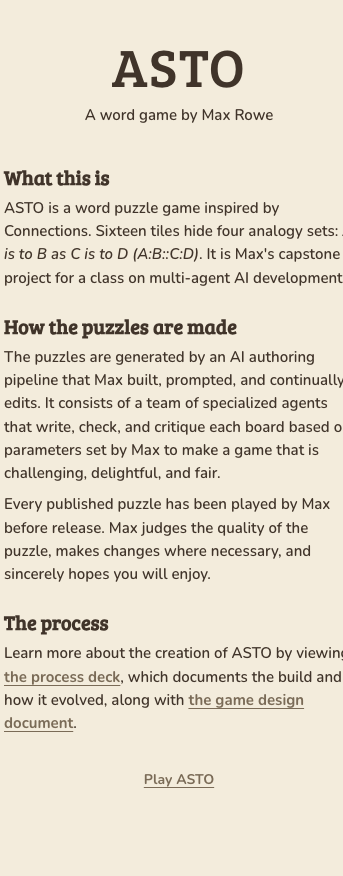
An About page states plainly that the boards are AI-generated and human-approved: every published puzzle was played by me before release. It is linked from the end screen as well as the homepage, because a shared link goes straight to a board and never passes the front door.

Go play it. The fastest way to evaluate everything this deck has claimed is one round at playasto.com. Come back for the last slide when you’re done.

The About page: the ASTO wordmark, then sections headed What this is, How the puzzles are made, and The process, stating that the puzzles are generated by an AI pipeline and that every published puzzle has been played and approved by Max.
The disclosure, as a visitor meets it.

Forward

Shipped, and still unfinished.

As of August 17, 2026 · playasto.com · the game design document

The open loop, named: the editorial rubric does not exist yet. The plan said thirty judged boards; there are 109. I would rather name the debt than have this deck imply it is done.

Where this goes next: Relics of the Nine, my systems-driven roguelike, is the next project this workflow gets pointed at. What transfers is the machine’s shape: generator, validators, an adversarial check, and a human editor whose taste is the standard.

What transfers

Not the game. The habit of writing down what was decided and why, of naming the trigger that would change my mind before I need it, of granting a machine authority only against evidence I wrote the standard for in advance, of keeping the failed experiment instead of the tidy summary, and of knowing which judgements are mine to make and which ones to go and borrow from someone who actually knows.

Validity can be delegated and checked. Taste is the product.